Are you a supplier?

We invite you to register on our platform and characterize your technological solution, so you can participate in the open innovation processes that we carry on for the main mining companies in the country
Register here
We invite you to register on our platform and characterize your technological solution, so you can participate in the open innovation processes that we carry on for the main mining companies in the country
Register here
Faena: Los Pelambres Mine
Deadline 09/03/2026
Closing Time 4:00 pm
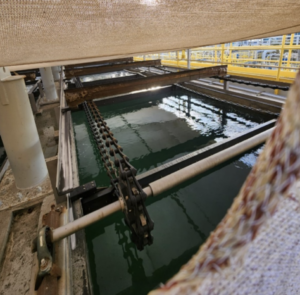
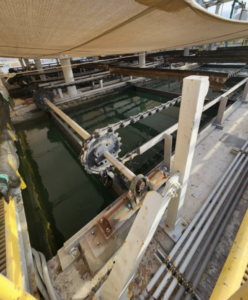
The Punta Chungo desalination plant of Minera Los Pelambres produces 400 L/s of desalinated water, with a feed flow rate of approximately 3,200 m³/h. The physical-chemical pretreatment process includes the addition of sulfuric acid and ferric chloride, followed by coagulation and flocculation stages, where the resulting flocs are removed through four dissolved air flotation (DAF) cells.
The operation of the DAF cells is based on the injection of compressed air from the lower zone, allowing the flocs to rise to the surface, where a low-speed skimming system conveys them toward the drainage points. The generated sludge is sent to the sludge treatment system located 10–20 m away from the cells.
During operation, it has been observed that the sludge stops floating properly and begins to accumulate at the bottom of the cells. Although the quality of the outlet water remains within acceptable ranges, the progressive accumulation of sludge represents an increasing operational risk. The DAF cells are fed independently but share a common discharge, which tends to become clogged, limiting the possibility of intervening in a single cell without affecting the rest of the system.
Additionally, the plant has process water tanks which, according to their engineering design, have sumps at their bottoms where water stagnates due to the suction points being located above them. In scenarios involving algae accumulation or ineffective chemical cleaning, a film of algae, colloids, or microplankton forms at the bottom of the tank, resulting in water of different quality compared to the rest of the tank volume.
The problem occurs progressively during normal operation of the DAF cells and becomes more severe especially in summer, when higher water temperatures and increased biological activity leads to greater sludge generation.
The progressive accumulation of sludge at the bottom of the DAF cells has reached critical levels, causing clogging of drainage systems and increasing the risk of unplanned operational shutdowns.
Currently, sludge accumulation is addressed through scheduled shutdowns, approximately every six months, during which the tanks are completely drained, and cleaning tasks are carried out using Supersuckers type equipment and/or manual cleaning.
The objective of this call is to identify a technological solution that enables automated sludge cleaning at the bottom of the DAF cells and in the sumps of the process water tanks, operating while the plant remains in service and contributing to reducing the risk of operational shutdowns.
Companies, startups, institutes, universities, research centers, and other legally established entities in accordance with the laws of their country of origin are eligible to apply. Natural persons (individual applicants) are excluded from this call.
We extend this invitation to foster collaboration and leverage technological and/or business capabilities among companies, entrepreneurs, and other entities. For teams or consortia, the lead institution must be clearly identified in the application.
Consulting services, advisory services, and engineering studies
Water quality:
Seawater containing microalgae and colloids (organic sludge), with an approximate conductivity of 54,000 µS/cm; pH between 6.8 and 7.8; addition of sulfuric acid and ferric chloride (1 to 4 ppm).
The proposed solution must meet a series of technical and operational requirements to ensure its feasibility within the company’s current and future context. These requirements include:
DAF cell dimensions:
The solution must be capable of effectively cleaning sludge accumulated at the bottom of the DAF cells, considering approximate dimensions of 3 m in height, 3.5 m in width, and 13 m in length, as well as a DAF outlet channel measuring 5 m in height, 1 m in width, and 5 m in length.
Additionally, the following structures must be considered:
Operational and environmental robustness:
The solution must be resistant to the highly corrosive marine environment. All structures and fasteners must be made of super duplex stainless steel, and the equipment must withstand continuous plant operation and special operating conditions. The use of lubricants and/or solvents for cleaning must be validated by Minera Los Pelambres’ Environmental Department.
Technology readiness level:
Solutions with a minimum TRL of 7 are accepted, meaning technologies that have been demonstrated and validated in a relevant operational environment under conditions similar to the intended industrial application.
Operational interference:
The solution must not interfere with the normal operation of the cell nor come into contact with its components. Temporary shutdown of the cell is permitted for equipment entry or initiation of cleaning; however, the cleaning operation must be designed to be carried out while the cell is in operation.
Automated operation:
It is desirable that the solution be automated or require minimal operator intervention.