Are you a supplier?

We invite you to register on our platform and characterize your technological solution, so you can participate in the open innovation processes that we carry on for the main mining companies in the country
Register here
We invite you to register on our platform and characterize your technological solution, so you can participate in the open innovation processes that we carry on for the main mining companies in the country
Register here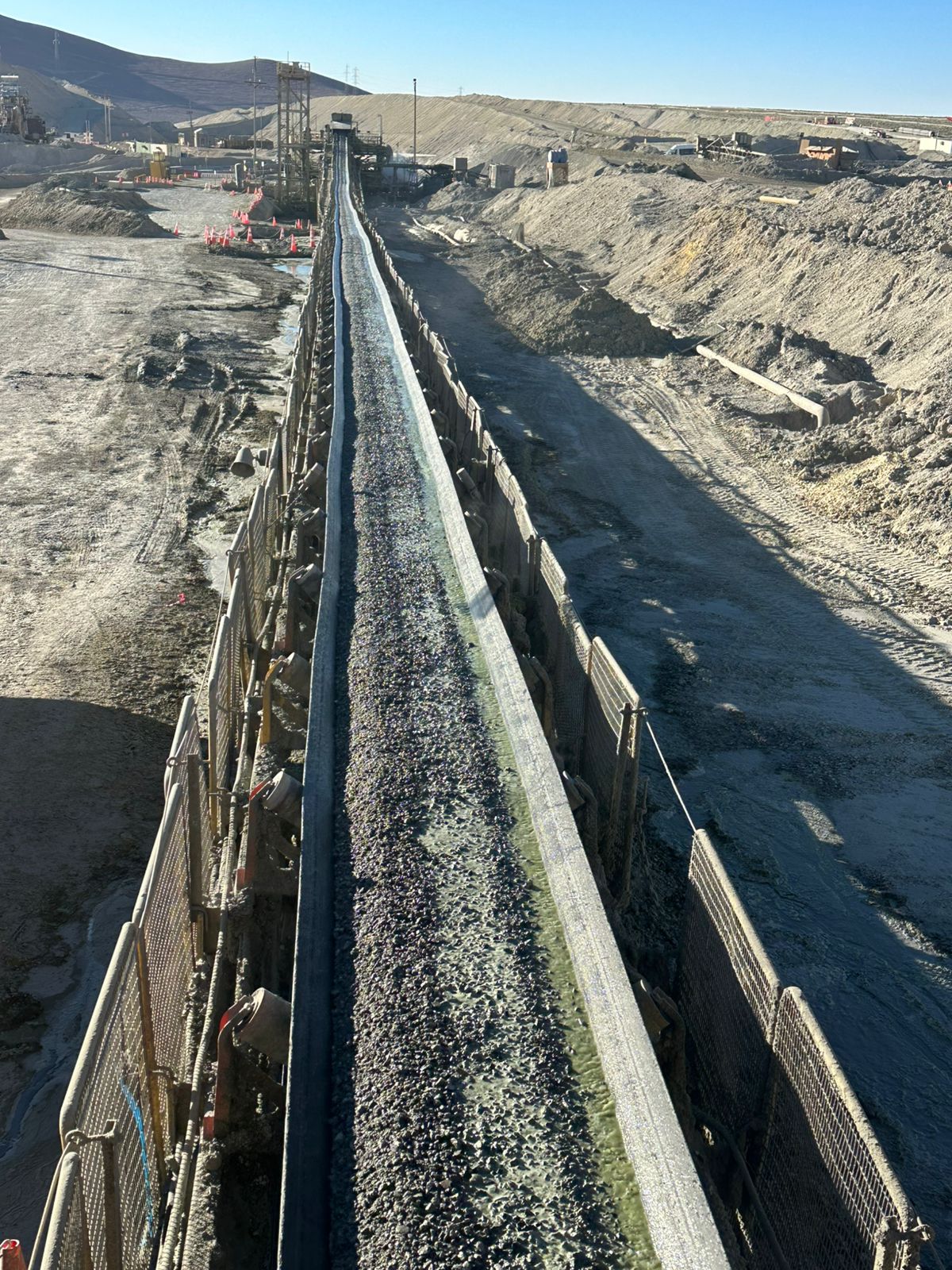
Faena: Zaldivar Mine
Deadline 03/03/2026
Closing Time 4:00 pm
Minera Zaldívar operates a heap leaching process in which the addition of acid and brine is carried out directly onto the conveyor belt during the stacking stage, without currently having a dedicated agglomeration system.
In the current configuration, the mixing between the ore and reagents depends mainly on belt transport and transfer points, which does not ensure homogeneous wetting of the material. This variability generates instability in mineral–reagent contact conditions, affecting metallurgical efficiency and reagent consumption.
In this context, the operation requires an intermediate technological solution that improves reagent application homogeneity, without modifying major infrastructure or affecting operational continuity.
Existing operating conditions:
The problem arises during the ore stacking stage, specifically along the section between the reagent addition point (acid and brine) and the conveyor head, over a distance of approximately 600 m.
Under current operating conditions, the residence time and available mixing mechanisms on the conveyor belt are insufficient to achieve adequate homogenization of reagents with the ore.
Currently, there is no specific solution implemented for this challenge. The process design considers the incorporation of an agglomeration drum starting in 2028; in the meantime, the operation runs under a transitional condition that requires an intermediate technological solution.
Implement a temporary technological solution that improves the homogeneity of acid and brine application and distribution within the ore during the stacking stage, without incorporating an agglomeration drum, compatible with the conveyor belt and transfer points, and without affecting operational continuity or performance. This solution will serve as an intermediate measure until the planned agglomeration drum comes into operation.
Companies, startups, institutes, universities, research centers, and other legally established entities in accordance with the laws of their country of origin are eligible to apply. Natural persons (individual applicants) are excluded from this call.
We extend this invitation to foster collaboration and leverage technological and/or business capabilities among companies, entrepreneurs, and other entities. For teams or consortia, the lead institution must be clearly identified in the application.
Consulting services, advisory services, and engineering studies
The proposed solution must meet the following requirements: